Build on your surgical experience with hands-on training in minimally invasive surgical gastroenterology, upper GI endoscopy and colonoscopy, under Dr. Neeraj Dhamija.
MINIMALLY INVASIVE GI SURGERY✦UPPER GI ENDOSCOPY✦COLONOSCOPY
FIND YOUR PATH
Two durations. One commitment to learning.
Build on your surgical training with a focused 3-month placement or a deeper 6-month immersion. Both combine supervised hands-on surgery with upper GI endoscopy and colonoscopy.
3MONTHSFOCUSED IMMERSION
3-month fellowship
₹3,00,000 INR + GST1 seat
Includes hospital fellow registration fee
GST at 18%: ₹54,000 · Total: ₹3,54,000
Focused hands-on learning in cholecystectomy, TEP and IPOM/IPOM Plus, together with upper GI endoscopy and colonoscopy.
Mentorship under Dr. Neeraj Dhamija
Supervised surgical & endoscopic participation
Foundation completion certificate
Explore the proposed monthly learning pathway and procedure objectives below.
GST at 18% is additional to the fellowship fees. Travel, accommodation, visa and temporary medical registration/licensing costs are additional and borne by the fellow. Payment is in one instalment, in full and in advance, after acceptance of the written offer. See the programme terms below for refunds.
THE FELLOWSHIP CURRICULUM
Learn the procedure. Develop the judgement.
Supervised hands-on surgery and GI endoscopy, connected through patient assessment, operative planning and follow-up.
PROPOSED ACADEMIC PROGRAMME
This curriculum is being developed by MIST Foundation. The final timetable and individual hands-on scope will be agreed before enrolment. Completion requires at least 90% attendance and a compulsory mentor review of hands-on work.
Close faculty mentorship
Train under Dr. Neeraj Dhamija, with one fellowship seat offered for each duration.
Surgery meets endoscopy
Connect laparoscopic technique with upper GI endoscopy, colonoscopy and clinical decisions.
Make progress visible
The proposed programme includes a personal learning plan, procedure logbook and regular faculty feedback.
CHOOSE YOUR LEARNING PATH
Three months or six?
Both options cover the same clinical areas. The longer fellowship allows more time for advanced cases and consolidation.
Core skills. Focused immersion.
A concentrated programme for surgeons seeking structured hands-on development in laparoscopic cholecystectomy, TEP, IPOM/IPOM Plus and diagnostic GI endoscopy, alongside exposure to advanced GI surgery.
MONTH 01
Orient & build foundations
Baseline skills review, clinical protocols, patient assessment and instrument handling. Begin supervised core laparoscopic participation and upper GI endoscopy training.
MONTH 02
Practise & connect skills
Focus on cholecystectomy and abdominal wall surgery, including TEP and IPOM/IPOM Plus. Develop colonoscopy skills, with case preparation, logbook review and feedback.
MONTH 03
Consolidate & review
Continue core surgical and endoscopic practice. Discuss fundoplication, right hemicolectomy, LAR and complex cases, with selected hands-on components where appropriate. Review progress and next learning goals.
At the end of your placementA documented review of your supervised experience, strengths and further training needs across the core modules.
A longer programme for surgeons seeking to consolidate core skills and spend more time on foregut, colorectal and complex abdominal surgery, with continuing hands-on upper GI endoscopy and colonoscopy.
MONTH 01
Assess & establish foundations
Individual learning plan, clinical protocols, laparoscopic fundamentals and upper GI endoscopy. Agree supervised responsibilities with the faculty.
MONTH 02
Develop core laparoscopy
Focused participation in cholecystectomy and TEP repair. Continue upper GI endoscopy and begin or extend colonoscopy training according to experience.
MONTH 03
Extend abdominal wall skills
IPOM/IPOM Plus, suturing and difficult-case discussions. Review progress in surgery and endoscopy, and refine goals for the second half.
MONTH 04
Explore foregut surgery
Reflux workup, fundoplication planning and supervised operative components. Relate endoscopic findings to surgical decisions and postoperative follow-up.
MONTH 05
Deepen colorectal exposure
Right hemicolectomy, LAR and selected complex abdominal cases. Emphasise anatomy, oncological judgement where relevant, reconstruction and complication recognition.
MONTH 06
Consolidate & demonstrate learning
Target remaining learning needs, consolidate endoscopy and review the procedure portfolio. Present a case review or small clinical audit and agree a further development plan.
At the end of your placementA broader supervised portfolio, review of progress in advanced modules and a proposed case presentation or clinical audit.
Month-by-month themes are indicative. Endoscopy and core surgical learning continue throughout both programmes; case availability and faculty assessment determine the actual sequence and level of participation.
YOUR PROCEDURE PORTFOLIO
Focused training. Across the GI pathway.
Explore the proposed learning objectives for each area. Hands-on opportunities progress from assistance to agreed procedural components under direct supervision.
01BILIARY SURGERYLaparoscopic cholecystectomyFrom gallstone assessment to the difficult gallbladder.
LEARNING OBJECTIVES
Patient selection, imaging review, operative planning and perioperative care.
Supervised participation in access, exposure and dissection, with emphasis on anatomical identification and the critical view of safety.
Recognising difficulty, discussing bailout strategies, and reviewing bile duct injury prevention and postoperative problems.
02ABDOMINAL WALLTEP inguinal hernia repairDevelop an understanding of the preperitoneal view.
LEARNING OBJECTIVES
Totally extraperitoneal (TEP) repair: selection, groin anatomy and preoperative planning.
Supervised participation in space creation, anatomical orientation, hernia dissection and mesh placement as appropriate to experience.
Recognising peritoneal breach, bleeding and other difficulties; discussing alternative approaches, recurrence and chronic pain.
03ABDOMINAL WALLIPOM & IPOM PlusUnderstand the repair, the defect and the alternatives.
LEARNING OBJECTIVES
Intraperitoneal onlay mesh (IPOM) repair and IPOM Plus, which includes fascial defect closure; patient and defect assessment.
Supervised participation in safe access, appropriate adhesiolysis, defect assessment, suturing and mesh placement/fixation.
Mesh planning, bowel injury prevention and recognition, seroma and recurrence; discussion of alternative abdominal wall repairs.
04FOREGUT SURGERYFundoplicationConnect reflux evaluation with operative decisions.
LEARNING OBJECTIVES
Review of reflux symptoms, upper GI endoscopy and relevant physiology investigations before surgery.
Hiatal anatomy, complete versus partial fundoplication selection, and supervised participation in exposure, dissection and suturing.
Case-based review of dysphagia, recurrent reflux, postoperative diet and follow-up.
05COLORECTAL SURGERYLaparoscopic right hemicolectomyPlan the resection and understand the reconstruction.
LEARNING OBJECTIVES
Indications, imaging, staging and multidisciplinary planning where relevant, with preparation and recovery pathways.
Vascular anatomy, dissection planes and oncological principles; supervised participation in selected mobilisation and resection components.
Bowel reconstruction and anastomotic judgement, specimen review and recognition of postoperative complications.
06COLORECTAL SURGERYLaparoscopic low anterior resection (LAR)Build your understanding of pelvic dissection.
LEARNING OBJECTIVES
Rectal disease assessment, staging and multidisciplinary treatment planning where relevant.
Pelvic anatomy, nerve preservation and mesorectal excision principles; supervised participation in selected operative components.
Anastomotic assessment, diversion decisions, leak recognition and postoperative bowel-function counselling.
07ADVANCED GI SURGERYOther complex abdominal surgeryLearn how experienced surgeons respond to complexity.
LEARNING OBJECTIVES
Selected complex GI, bowel and reoperative cases according to the clinical lists and the fellow’s agreed learning needs.
Safe access in a previously operated abdomen, adhesiolysis, tissue handling and intraoperative decision-making.
Faculty-led discussion of escalation, conversion, complication management and when a different approach is appropriate.
08ENDOSCOPYHands-on upper GI endoscopyCombine scope handling with a systematic examination.
LEARNING OBJECTIVES
Indications, consent, preparation, sedation safety principles and infection prevention within the host unit’s protocols.
Supervised scope handling and examination of the oesophagus, stomach and duodenum, with landmark and lesion recognition.
Biopsy when indicated, image documentation, reporting and aftercare; selected therapeutic exposure only when appropriate and faculty-approved.
09ENDOSCOPYHands-on colonoscopyDevelop insertion, inspection and reporting skills.
LEARNING OBJECTIVES
Patient selection, bowel-preparation assessment, consent, comfort and safe procedural practice.
Supervised insertion, loop recognition and management, landmark identification and careful withdrawal with mucosal inspection.
Lesion documentation, indicated biopsy and suitable basic polypectomy under supervision; reporting, quality review and complication recognition.
HOW HANDS-ON LEARNING PROGRESSES
Responsibility grows with demonstrated skills.
Begin with a review of your experience and learning goals. Practise under direct supervision, receive feedback and take on further components when the faculty considers you ready. The proposed progression can include a complete suitable procedure under supervision when explicitly authorised by faculty.
Participation requires patient consent and host-institution approval, with the necessary registration or permissions in place. Procedure numbers and independent operating competence are not guaranteed by the duration of the fellowship.
01
Prepare the case
Discuss indications, investigations, anatomy, alternatives and the agreed role of the fellow.
02
Participate under supervision
Assist and perform selected surgical or endoscopic components appropriate to the patient and your assessed skills.
03
Reflect & progress
Review decisions, document your role in a de-identified logbook and agree the next learning objective with faculty.
BEYOND THE OPERATING ROOM
A proposed rhythm for meaningful learning.
Clinical lists and perioperative care, case planning, anatomy and operative-video discussions, endoscopy reporting, journal review and regular logbook feedback.
FEEDBACK & COMPLETION
Review the experience you have gained.
Proposed assessments include an entry skills review, periodic observed performance and a final portfolio discussion. At least 90% attendance and a compulsory mentor review of hands-on work are required. Detailed review criteria will be shared before enrolment; the foundation certificate records programme completion.
Medical registration Delhi Medical Council · Registration No. DMC/R/03224
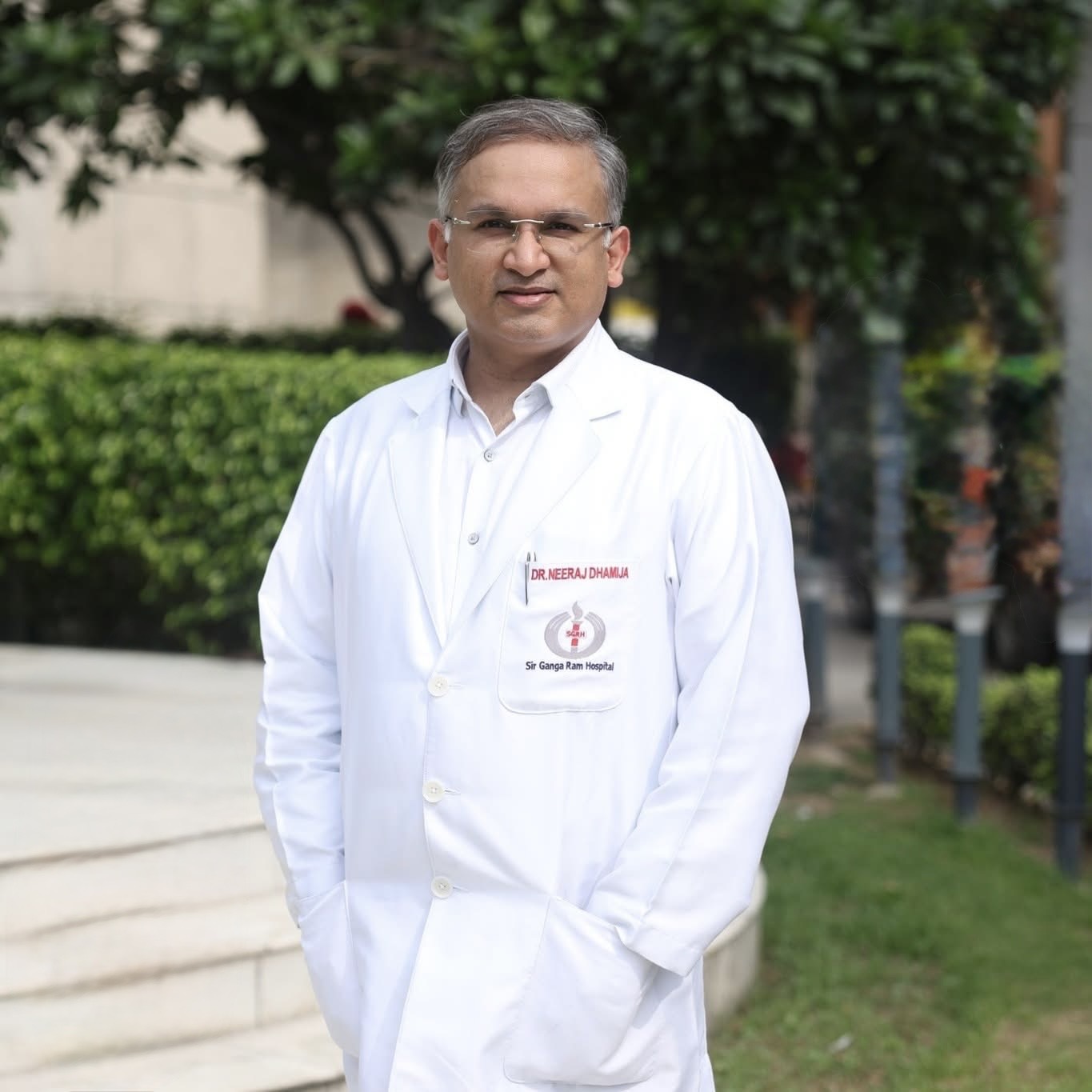
Senior Consultant Surgical Gastroenterologist at Sir Ganga Ram Hospital, New Delhi, and Director of Gastro Surgery & Stone Centre, Janakpuri.
His practice spans laparoscopic and robotic GI surgery, hepatobiliary and pancreatic surgery, colorectal and bariatric surgery, and hernia surgery.
His professional website reports over 20 years of experience, an Assistant Professor role at the Ganga Ram Postgraduate Institute, and contributions to peer-reviewed research.
Contact your mentor
For course clarifications or other queries, email Dr. Neeraj Dhamija directly.
Profile and photograph sourced from Dr. Dhamija’s professional website. Medical registration details and host-centre approvals confirmed by Dr. Dhamija for MIST Foundation.
Qualifications & training
2000–2005
MBBS
Bharati Vidyapeeth Deemed University, Pune
2006–2009
DNB · General Surgery
Sir Ganga Ram Hospital, New Delhi
2009–2010
GI Surgery & Liver Transplantation Fellowship
Sir Ganga Ram Hospital · Gyan Burman Fellow
2012
FACS
Fellow, American College of Surgeons
2014
Robotic GI & Colorectal Surgery Training
IRCAD, Strasbourg, France
FELLOWSHIP
FIAGES
Indian Association of Gastrointestinal Endo Surgeons
THE PEOPLE & PURPOSE BEHIND MIST
A foundation for hands-on learning.
Minimal Invasive Surgical Training Foundation
MIST brings together surgical mentorship and practical GI endoscopy training for qualified surgeons taking the next step in their clinical development.
Led by Dr. Dolly Mamtani and Dr. Neeraj Dhamija, the foundation’s fellowship programme connects focused learning with the day-to-day decisions of surgical practice in New Delhi.
DIRECTORDr. Dolly Mamtani
DIRECTOR & FELLOWSHIP MENTORDr. Neeraj Dhamija
Founded in 2018 · New Delhi, India
Our beginning
Incorporated as Pancretic Disease Foundation, a company limited by guarantee.
The MIST name
The Registrar of Companies recorded the change of name to Minimal Invasive Surgical Training Foundation.
FOUNDATION DETAILS
Our registered identity.
Registered name
Minimal Invasive Surgical Training Foundation
Corporate Identity Number (CIN)
U85300DL2018NPL338532
GSTIN
07AAKCP0546K1Z7
Company constitution
Company limited by guarantee
Registrar
Registrar of Companies, Delhi
Foundation office & billing address
C4E/190, Janakpuri, West Delhi New Delhi, Delhi – 110058, India
Details drawn from the foundation’s incorporation and name-change certificates and supplied billing information.
Fellowship training takes place at Sir Ganga Ram Hospital and Gastro Surgery & Stone Centre. MIST Foundation confirms that both centres have approved hosting these fellowships.
01 / HOSPITAL
Sir Ganga Ram Hospital
Sir Ganga Ram Hospital Marg New Delhi – 110060, India
02 / CENTRE
Gastro Surgery & Stone Centre
C4F/247, Janakpuri New Delhi – 110058, India
YOUR NEXT STEP
From interest to a conversation.
First intake planned from 10 January 2027. Dr. Neeraj Dhamija personally reviews enquiries, with a usual reply within 2–3 working days.
For doctors ready to build on their surgical training.
Completed postgraduate surgical training with a degree equivalent to MS or DNB Surgery in India, and a special interest in minimally invasive surgical gastroenterology, upper GI endoscopy and colonoscopy.
Applications welcome from India and across the world. Qualification equivalence and eligibility are reviewed by the foundation.
01
Introduce yourself
Share your qualifications, current CV, experience, preferred duration and learning interests. Recommendations are optional.
02
Discuss your programme
Discuss your eligibility, curriculum, hands-on scope, start dates and programme terms with Dr. Neeraj Dhamija.
03
Confirm your place
Enrol only after receiving and accepting the foundation’s written offer and programme terms.
Coming from overseas?
The foundation can facilitate travel, chargeable accommodation, visa support and temporary medical registration/licensing assistance. All related costs are borne by the fellow; approvals remain subject to the relevant authorities.
BEFORE YOU COMMIT
Clear programme terms.
Completion
At least 90% attendance and a compulsory mentor review of hands-on work are required for the foundation’s completion certificate. The detailed review criteria and timetable will be provided before enrolment.
Cancellation by the fellow
More than 90 days before commencement: 100% refund.
The foundation stores your enquiry, current CV and any recommendations for admissions review by Dr. Neeraj Dhamija and to respond to you. Uploaded documents are stored privately and are not public downloads. Please include only professional and contact information. Do not send patient records, passport details or payment information.
Share recommendation letters only with the referee’s permission. Our website provider stores your enquiry and private documents. When automatic notifications are enabled, Resend processes your name, email address and enquiry reference to send an acknowledgement to you and an alert to the foundation. CVs, recommendation letters and other application details are not sent through Resend. Unsuccessful or inactive enquiries and uploads are deleted after 12 months from closure or the last substantive contact, whichever is later, subject to justified legal retention. See the full information policy. For questions about your information, or to request correction or deletion, contact contact@mistfoundation.in.
Applicants must have completed postgraduate surgical training with a qualification equivalent to MS or DNB in Surgery in India, and have a special interest in minimally invasive surgical gastroenterology, upper GI endoscopy and colonoscopy. Applications are welcome from India and worldwide. Final eligibility and qualification equivalence will be reviewed by the foundation.
What support is available for international fellows?
The foundation can facilitate travel, chargeable accommodation, travel or training visa support, and assistance with temporary local medical registration or licensing. All associated costs are borne by the fellow. Support does not guarantee visa or licensing approval; required permissions must be in place before clinical participation.
What does hands-on training include?
Both options emphasise supervised hands-on learning in laparoscopic surgery, upper GI endoscopy and colonoscopy. The proposed curriculum covers cholecystectomy, TEP, IPOM/IPOM Plus, fundoplication, right hemicolectomy, LAR and selected complex abdominal surgery. Participation progresses according to assessed skills, patient suitability and consent, case availability, host approval and required permissions. No minimum procedure numbers are promised.
How do the 3-month and 6-month curricula differ?
The proposed 3-month pathway concentrates on core laparoscopic procedures and GI endoscopy, with exposure to advanced GI cases. The 6-month pathway adds time for foregut, colorectal and complex surgery, ongoing endoscopy consolidation and a proposed case review or clinical audit. Advanced procedures are learning areas in both options; the level of hands-on participation is assessed individually.
What are the fellowship fees and inclusions?
The 3-month hands-on fellowship costs INR 3,00,000 + GST and the 6-month hands-on fellowship costs INR 5,00,000 + GST. Each fee includes the hospital fellow registration fee. Travel, accommodation, visa and temporary medical registration/licensing costs are additional and paid by the fellow. GST is 18%: totals are INR 3,54,000 for three months and INR 5,90,000 for six months. Payment is in one instalment, in full and in advance, after acceptance of the written offer. See the programme terms for cancellation and refunds.
Who issues the completion certificate?
The completion certificate will be issued by the Minimal Invasive Surgical Training Foundation. Completion requires at least 90% attendance and a compulsory mentor review of hands-on work. This website does not claim university accreditation or eligibility for independent clinical practice.
Where will I train, and how many seats are offered?
Training takes place at Sir Ganga Ram Hospital and Gastro Surgery & Stone Centre in New Delhi, India. There is one seat for the 3-month programme and one seat for the 6-month programme. The first intake is planned from 10 January 2027. Your specific start date and seat availability are confirmed in the written offer. Accommodation can be arranged on a chargeable basis.
MIST ON YOUR PHONE
Your next visit, one tap away.
Add MIST to your home screen for quick access to fellowship details and enquiries.
Available on Android, iPhone and iPad. An internet connection is needed for current information and enquiries.